Showing posts with label Washington. Show all posts

Sunday, October 19, 2014

New World vs. Old World

As the line between new world and old world wines continues to blur, last week at San Francisco Wine Center we found ourselves stumped this evening as we blind-tasted through 6 comparisons of typical varietals made by old world and new world producers. With each pair, the class was literally split every time on which was which. As Mary Burnham, wine writer, explained, when we talk about old world, we mean Europe, while new world encompasses everywhere else. Old world wines are generally more earthy and savory, with marked acidity and minerality and less alcohol. New world wines are typically more fruit-forward, less acidic, and higher in alcohol. Did these generalizations hold up in this group?

In the first pair, wine #1 was fruity and dry, with grassy notes, citrus peel, and marked acidity. Many guessed it was a New Zealand Sauvignon Blanc - but it was a white Bordeaux. Wine #2 was creamier, with sweet vanilla oak, lemon merengue, and peach; more complex, silky but still crisp. Were we in Pouilly-Fumé, France? Actually, Washington State. I didn’t even know anyone was making Sauvignon Blanc in Washington – this was actually majority Semillon (61%) with 20% Sauvignon Blanc – but I expect I will be re-visiting this producer, Buty.

In the next pair, many immediately thought #3 was a German Riesling due to its pungent petrol character. I got beyond that and began to think we were in Australia, since theirs take on that character as well but tend to be very lime-y and dry, which was how I would characterize this wine.  Wine #4 was more floral and peachy, like many Rieslings I’ve had from Finger Lakes producer Hermann J. Wiemer that highly mimic a German Mosel style when young.  The big reveal - #3 was from Oregon and #4 was Austrian!

The next two sets were a bit more obvious to me – Chardonnay and Pinot Noir. New World chardonnay tends to have more pronounced oak, and I almost always prefer a more refined French style. With Pinot Noir, new world versions tend to be very fruity, whereas French versions are more funky and earthy, which I also prefer. Both sets were more typical expressions of new world and old world, though not obvious to everyone.

The second set of reds was a fun one – meaty, savory and spicy with firm tannin against brambly, sweet spice and soft tannin. We had ourselves a Crozes-Hermitage Syrah against a Barossa Valley Shiraz. We learned that the Barossa Valley does not cool off at night, so the grape skins don’t thicken, contributing to softer tannins in the wine. This was a great pair that solidified my favorite for the night in the Crozes-Hermitage, since I love this style and producer and the price cannot be beat, especially for a wine that will continue to improve with cellar time.
The last set was another tough one, mostly because both these wines were very tight and could use some more aging and air. The first had a eucalyptus nose with black fruit and violets on the nose. The second was a bit more closed on the nose but we could discern some vanilla. With a few bites of cheese, things started to become clearer - these were Cabernet-dominated wines, Bordeaux from Graves against Napa Valley’s Opus One.

A wonderful selection of wines with some curveballs…
  1. Chateau Lamothe de Haux White Bordeaux 2011 ($15)
  2. Buty Semillon-Sauvignon Blanc-Muscadelle 2010 – Columbia Valley, WA ($25)
  3. Chehalem Willamette Valley Dry Riesling Reserve 2007 – Oregon ($20)
  4. Hogl Wachau Riesling Smaragd Bruck 2007 – Wachau, Austria ($30)
  5. Domaines Leflaive Macon Verze 2012 – Burgundy, France ($39)
  6. Wente Riva Ranch Estate Chardonnay 2012 – Arroyo Seco, Monterey, CA ($18)
  7. Flowers Van der Kamp Vineyard Pinot Noir 2000 – Sonoma Mountain ($60)
  8. Domaine Trappet Chambertin Grand Cru 2000 – Cote de Nuits, Burgundy, France ($200)
  9. Alain Graillot Crozes Hermitage 2012 – Northern Rhone Valley, France ($30)
  10. Two Hands Gnarly Dudes Shiraz 2011 – Barossa Valley, Southern Australia ($28)
  11. Chateau Smith-Haut Lafite 2006 – Graves, Left Bank, Bordeaux, France ($90)
  12. Opus One 2006 – Napa Valley, CA ($290)


Tuesday, May 1, 2012

Why We Love(d) the 90's

A few weeks ago I visited Indiana with my boyfriend and we raided his dad's wine cellar. His dad had managed to get himself on a bunch of coveted wine lists in the 80s and 90s and still has a lot to show for it. Now a diabetic, he doesn't drink wine as much as he used to, so he said we could put together a couple cases and bring them back to California with us. I've been lucky enough to sample some of these cellar treasures, including Ridge from the 80s and Leonetti from the 90s. It is always a gamble with older wines - you never know how they will keep. This basement wine cellar that we raided is not actually a wine cellar at all - it's a boiler room. So every time we open one of these bottles, the cork crumbles, we dismantle it in pieces, push in what we can't get out, and usually end up decanting and sometimes passing the wine through a coffee filter (into a coffee pot if we've run out of decanters). The wine may be oxidized, it may have lost all its fruit. Or it may be amazing, complex, funky, silky, and downright delicious. Here are a few winners from the latest collection:

 Leonetti Cellars 1992 Select Walla Walla Valley, Washington
The components of this wine are unknown, but I suspected it was a Merlot/Cab Sauv blend. It was gorgeous, fruity, spicy and chewy, with no oxidation and a beautiful richness.

Newton 1990 Merlot Napa Valley, California
This wine wasn't as clean as the previous but still had a lot of fruit and spice to go with the funk.

Chateau Phelan Segur 1990 Saint-Estephe, Bordeaux, France
This 1990 Bordeaux, which is dominated by Cabernet Sauvignon in the blend, still had a lot of fruit, plus richness and complexity that is so typically Bordeaux. I've learned through my tasting and study that really good Bordeaux needs at least 10 years to be drinkable, at least to my liking (the tannin needs time to calm down) and this was a perfect example. Blackberry, leather, barnyard, and dried fruit mingled with a surprising acidity (that calmed down after being open for a day) and tannin that suggested we could have waited a bit longer to open it, but not too much longer. 

A. Rafanelli 1991 Zinfandel Dry Creek Valley, Sonoma County, California
I tried this wine after it being open for a day, and it was pretty oxidized, but it still had a bit of fruit and spice and was drinkable. Jeremy said it was much better the first day.

Both of these last two bottles had been leaking, which was why we decided to open them. You can see how the bottle tops are kind of moldy and icky. 

All of these wines threw a lot of sediment, as can be expected in older wines, and the 1990 Bordeaux also left tartrate crystals behind, which is from the acidity precipitating out. 

We were just saying that we should probably get some cheap Tuesday night wine to drink so we are not opening interesting and potentially amazing 20-year old bottles on a whim, but really, we are opening the bottles from Indiana assuming they are bad from the storage conditions, but hoping they will surprise us. So far so good! Thanks again, Jeff.

Sunday, December 4, 2011

Giving thanks to Leonetti


This Thanksgiving I got to try 2 bottles of 1996 Leonetti Cellars Walla Walla Cabernet Sauvignon. The corks were difficult to extract, so both bottles were decanted. The first was actually decanted with a significant amount of cork pieces, so we then filtered it through coffee filters (yes, it's the one in the coffee pot). The second bottle was a little easier to open so we decanted it without any floaters. I was so curious to try both wines and see if there was a difference, and there was! The non-filtered version was much brighter and fruitier. The filtered one lacked that vibrancy. I tried the filtered one first, and don't get me wrong, it was delicious. But then when I tried the non-filtered one it tasted even better. When I was working at Wiemer, Fred the winemaker taught me that everything you do to a wine robs it of some character - every racking, every filtering. This could have been one such example of the truth in his words. (But in a finished wine like this, there is always the chance of bottle variation, especially in wines that have aged.)


I like how Leonetti's labels say "Appellation American." Happy Thanksgiving!

Thursday, November 10, 2011

Wine & Spirits' Grand Tasting


Last month my friend Oskar visited from the Finger Lakes and invited me to join him at the Wine & Spirits Top 100 Tasting, honoring the San Francisco-based magazine's chosen top 100 wineries of the year. Hermann J. Wiemer Vineyard was honored for the 3rd year in a row, and I got to accompany Oskar as a representative of the winery. Going to industry tastings is always more fun with 2 people - you can share the responsibility of pouring the wine while having the chance to walk around and taste the other wines.

The best part was the Champagne and oysters section on the veranda of City View at METREON in downtown/SoMa San Francisco - great views and delicious indulgences. I tried Dom Perignon for the first time (it was ok; I've had better for cheaper) and sampled some other great names like Louis Roederer.

In the Riesling family, in addition to Wiemer's 2010 Gewurztraminer and 2009 Late Harvest Riesling, wines that I proudly helped produce, I enjoyed Joh. Jos. Prum's 2009 Mosel Wehlener Sonnenuhr Riesling Spatlese (Germany), a similar style to our Late Harvest Riesling, and Loimer's 2009 Kamptal Reserve Langenlois Steinmassl Riesling and 2010 Kamptal Gruner Veltliner (Austria). I love this simple green label:


Again I sampled R. Lopez de Heredia's 1993 Rioja Reserva Vina Tondonia Blanco, the white Rioja I first had at San Francisco Wine Center over the summer; this is such an interesting wine. I also had their 2001 Rioja Reserva Vina Tondonia Tinto, the red version. Delicious Spanish wines.

Other notable reds included Leonetti Cellar's 2008 Walla Walla Valley Cabernet Sauvignon and 2009 Walla Walla Valley Merlot. I've had older Leonetti vintages and they have been divine, so it was nice to try the current releases and see what the wine is like in its youth. I also enjoyed Achaval-Ferrer's 2008 La Consulta Uco Valley Finca Altamira Malbec. I visited this winery during my trip to Mendoza last year but I hadn't tried this single vineyard Malbec.

I had fun bumping into Mary Burnham and Jordan Mackay, wine writers and instructors at SFWC wine school.

And as always, it was great pouring Wiemer to adoring fans from around the country.

Other coverage:
http://www.vinography.com/archives/2011/10/whats_your_best_wine_tasting_t.html

Tuesday, April 12, 2011

Over the Hill

Last weekend I went to a crazy party at a community center in San Bruno, featuring a Zydeco band and honoring the birthday of a friend's mother. I didn't know it was BYOB until I got there, so all I had was a bouquet of flowers for the birthday lady. Someone brought a bottle of 1975 Chateau Ste. Michelle Cabernet Sauvignon, and I was invited to try it. Chateau Ste. Michelle is Washington state's oldest vineyard, dating back to the 1950s after prohibition, and this was the oldest wine I've ever tasted! It was super interesting on the nose, with very developed, almost vegetal aromas plus some stewed fruit. On the palate it had good structure and flavor, very complex but with almost no fruit flavor left. Still, I was impressed, until I got to the finish, which is where it fell off. It was oxidized, unfortunately, so the finish was a bit sour. Maybe 5 years ago the wine would have been at its best. Still, it was really interesting to experience. Thanks to Michael and Stephanie for a great party and for grabbing me to try this!

Sunday, October 31, 2010

Cellar Treasures

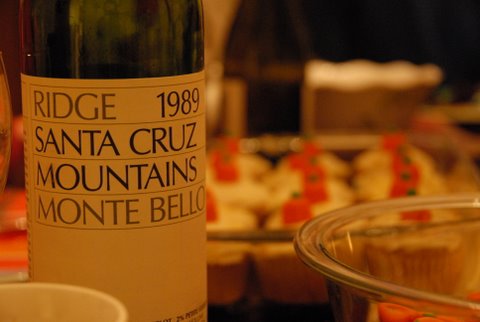
I thought I didn't like Cabernet Sauvignon until I had a 22-year old one from Caymus Vineyards in Califonia that was as smooth as silk. I thought Merlot was a simple, fruity, easy-drinking wine for burgers until I had an old one from Washington that was so complex I thought it was Bordeaux. I thought Bordeaux blends had no comparison until I had the 1989 Ridge Monte Bello from California (Cabernet Sauvignon, Merlot, Petit Verdot).


So, I guess what I've learned is that for me, Cabernet Sauvignon should be at least legal before I drink it; well-made wines may be even more rewarding/exciting/complex if you wait a decade or two to drink them; and finally, try anything, because you never know what you may like (or love!).