Tuesday, December 28, 2010

Riddle me this


Winter at Wiemer winery is a time for catching up on records, monitoring fermentations, and riddling sparkling wine. We pulled out the riddling racks 2 weeks ago and set up to riddle the 3rd disgorging of our 2006 Cuvee Brut, a dry sparkling wine comprised of Chardonnay and Pinot Noir. We are experimenting a little with this sparkling wine to see how varying amounts of time on the lees affect the flavors. Aging on the lees tends to impart classic Champagne flavors to a sparkling wine, like brioche and biscuit. The current release of 2006 Cuvee Brut was disgorged in 2009, and it has some really lively, toasty flavors. The process of riddling includes a partial turn of every bottle each day for 3 weeks, with the intent being to force the yeast sediment (the lees) from the second fermentation into the neck of the bottle so it can be removed during disgorgement.


With each turn the line of sediment gradually cleans the inside of the bottle, resulting in a clear wine. After the riddling cycle has been completed, the bottles will be stored completely upside down until it is time for disgorgement. During disgorgement, we'll take the bottles outside in the dead of winter when it is good and cold so that the sediment in the necks freezes. Then we'll open the bottles, the yeast plug will shoot out, and we'll top off, cork, seal, and label the bottles. This should happen sometime in January or February. In the meantime, I'll keep turning.

Sunday, December 12, 2010

Top 100 Wine

Wine Spectator has announced its Top 100 most exciting wines of the year, and Hermann J. Wiemer's Dry Riesling Reserve 2008 made the list! 2008 was an exceptional vintage for the Finger Lakes and for us. Our wines have been scored the highest in our history by the major trade publications. We are very proud of this recognition and the wine - we just wish we had more of it! A limited quantity still remains; I'm glad I bought a half-case before we even knew about the award.

Thursday, November 25, 2010

Pre-Thanksgiving dinner


Last night at my boyfriend's parents' house we had a decadent pre-Thanksgiving dinner, featuring rack of veal and 2 cellar treasures. Both wines were twenty years old and the corks were a bit soft. So, after they crumbled under the corkscrew we ran the wines through a coffee filter and into a decanter (and vase, as the case was for the second bottle!). I don't know if there is a gizmo out there to filter out disintegrated cork but if not maybe this is an invention waiting to happen. The filtering and decanting exercise was actually great for aerating the wines. Older wines tend to need a little time to open up so this was perfect.

The 1990 Ridge Monte Bello from California was a mix of Cabernet Sauvignon, Merlot, and Petit Verdot. It was expressive and fruity with a little spice and really smooth oak. The 1989 Lynch-Bages from Bordeaux was more complex and richer, with deeper tobacco and coffee nuances layered over the dark fruit.

Both wines went great with the rack of veal.

Happy pre-Thanksgiving!

Sunday, November 14, 2010

Second Harvest


When I hear Second Harvest I think of the Wiemer Nursery, which we harvest in early to mid November after all the grapes have been pressed to tanks and the reds are fermenting in bins. But for wine, some consider the harvesting of botritysed fruit or fruit left on the vine for another reason to be the second harvest. Seneca Lake's Bloomer Creek vineyard, located on the 'other' side of the lake (the east side) makes a dry second harvest wine from botrytised Riesling. Where we would make dessert wine from this fruit, they let it ferment dry instead of stopping the fermentation and leaving the high residual sugar that makes some of the best dessert wines. I tried this wine at Stella's, a bar and restaurant in Cornell's collegetown. It smells typical of a late harvest wine, with apricot, honey, and some botrytis spice. But then on the palate it is dry, with rich flavors that are not quite in balance with the crisp acidity and high alcohol for a Riesling. Interesting - but I think this fruit is better suited to the dessert wines so cherished in Germany, Sauternes, and at Hermann J. Wiemer.

Sunday, November 7, 2010

Wiemer vs. old and new - a wine dinner


This week some friends of Wiemer winery hosted a dinner for us featuring our wine. It was meant to be a comparison of old world versus new world for 3 varieties that we make: Riesling, Cabernet Franc, and Pinot Noir. We started with a tank sample of our HJW Single Vineyard Riesling, in the early stages of fermentation. Wine at this stage is called Federweiser in German. It is sweet and effervescent and very exciting at this stage.  With the traditional German onion tart, it was a delightful way to begin the evening.

The food was all delicious, and the pairings were excellent. Now for the wines...

The first course presented our 2005 Riesling next to one from Alsace, France (old world) and one from Oregon (new world).  Hands down, I enjoyed our Riesling the most, with its vibrant acidity and impeccable balance - a great compliment to the smoked rainbow trout. The Alsatian Riesling fell a bit flat, and the Oregon Riesling was a bit too rubbery for me.

The Cabernet Franc comparison was great, with our Reserve standing up quite well to the classic home of Cabernet Franc - Chinon, France. The California Cab Franc was very fruit forward but lacked the complexity of the other two. I'd say we tied with France in this comparison.

The last course was interesting and the results surprised me. Having taken a trip to Oregon a few years ago to explore their Pinot Noir, I had high hopes for the Benton Lane. However, I was taken with the German Spatburgunder (their name for Pinot Noir) from Baden. This was my favorite wine of the evening. Earthy, luxurious, balanced - it was a pleasure to drink. I believe this is the style we are going for with our Pinot Noir, and our 2008 is showing great promise. The Benton Lane tasted over extracted and thin, which was disappointing.

I've always known that I prefer old world wines - they tend to be refined, balanced, comfortable. This exercise reinforced the fact that we are going for this style at Hermann J. Wiemer, and I think we are heading in the right direction.

Thanks again to Ross and Heide for hosting such a delicious and educational dinner!

Sunday, October 31, 2010

Cellar Treasures

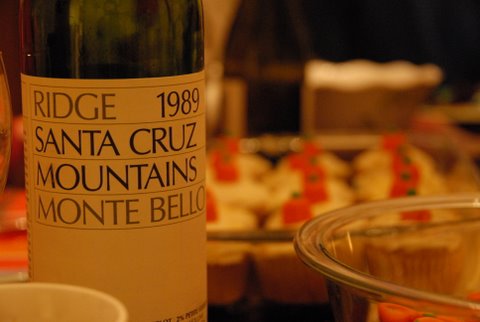
I thought I didn't like Cabernet Sauvignon until I had a 22-year old one from Caymus Vineyards in Califonia that was as smooth as silk. I thought Merlot was a simple, fruity, easy-drinking wine for burgers until I had an old one from Washington that was so complex I thought it was Bordeaux. I thought Bordeaux blends had no comparison until I had the 1989 Ridge Monte Bello from California (Cabernet Sauvignon, Merlot, Petit Verdot).


So, I guess what I've learned is that for me, Cabernet Sauvignon should be at least legal before I drink it; well-made wines may be even more rewarding/exciting/complex if you wait a decade or two to drink them; and finally, try anything, because you never know what you may like (or love!).

Monday, October 11, 2010

Machine harvesting do's and don't's

DO follow behind and pick up what gets missed - the machine is not perfect and every little grape helps

DON'T follow too close behind or you'll miss the fall foliage and the fresh air in the vineyard

DON'T let the picked grapes sit too long after harvesting - their close contact with the leaves and stems can impart an unwanted 'steminess' to the juice

DO sort quickly, removing as many leaves and stems as possible, as well as any other M.O.G. (Material Other than Grapes)

DO run the grapes through the Crusher/De-stemmer to further eliminate M.O.G.

Finally, DON'T machine harvest unless you are under time pressure! Hand-picking is usually best.

Saturday, September 18, 2010

Harvest mascots

Since I've been working at a winery I am now very much at home with nature. Snake in the vineyard - big deal. Bugs and worms on the sorting table - no problem. Recently there have been some cute animals wandering into the winery.

First day of harvest - this guy jumped in:


The frog eventually hopped out when he saw how busy we were bringing in the first juice of the harvest.

And the other day, this pretty lady flew in:


Sarah, our intern from Germany, caught this Hummingbird and set it free.

Gewurz me

Last week we harvested the first block of Gewurztraminer from our Josef vineyard up in Dresden, NY.  For the first picking of Gewurztraminer we focus on capturing crisp, natural acidity in the grapes. Usually 2 weeks later we will harvest the rest, giving it time to develop more rich, ripe flavors and higher natural sugar content.


The Magdalena block will hang another week or so before we harvest it:


Gewurz grapes are my favorite wine grapes to eat, so I don't mind the fact that the sorting takes a long time. I eat my way through it. Sometimes you just have to sample the grapes to make sure the bunch is good enough to go into the press. If it's underripe, we reject it. Good grapes in, good wine out.

Sunday, September 12, 2010

Do you remember?

Just as harvest was beginning we went back to bottling - just the wine for sparkling was left for this bottling cycle.  We had added the sugar back in August (remember this is a crucial step in sparkling winemaking because the yeast need something to eat in order for the second bubble-producing fermentation to occur) and were waiting for the yeast. Once we added the yeast, we inoculated by adding a bit of wine to the right amount of yeast to get things going. We let it sit overnight and then for another full day before we added it to the tank and mixed it into the wine. Then we were ready to bottle - first the Chardonnay for Blanc de Blanc, and then the Pinot Noir for Brut Rose. This time bottling was a little different since instead of using corks we use metal caps. This closure ensures a tight seal so the wine can undergo the second fermentation in the bottle without losing any of the carbon dioxide (or exploding/leaking). A team of 5 of us carefully ran the bottles through the line and the capper, and then arranged the bottles in horizontal stacks in wooden bins. The bottles will stay like this for about 2 and a half years. The actual fermentation will only take a couple of weeks, but then the wine will sit on the dead yeast cells, or lees, for an extended period of time. (In French this position is called en tirage.) The contact with the lees actually contributes to the classic Champagne-like flavors that are so desired in a sparkling wine - toasty, biscuity, brioche characteristics.

The Chardonnay Blanc de Blanc is in the classic green Champagne bottle:


The Pinot Noir Brut Rose looks so pretty in its clear bottle: