Sunday, October 31, 2010

Cellar Treasures

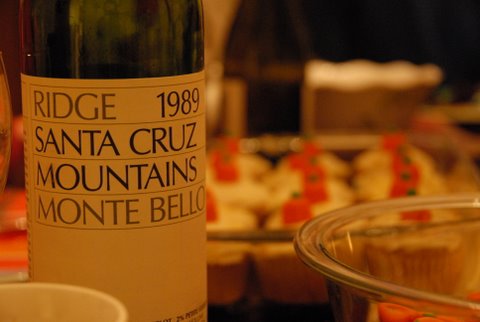
I thought I didn't like Cabernet Sauvignon until I had a 22-year old one from Caymus Vineyards in Califonia that was as smooth as silk. I thought Merlot was a simple, fruity, easy-drinking wine for burgers until I had an old one from Washington that was so complex I thought it was Bordeaux. I thought Bordeaux blends had no comparison until I had the 1989 Ridge Monte Bello from California (Cabernet Sauvignon, Merlot, Petit Verdot).


So, I guess what I've learned is that for me, Cabernet Sauvignon should be at least legal before I drink it; well-made wines may be even more rewarding/exciting/complex if you wait a decade or two to drink them; and finally, try anything, because you never know what you may like (or love!).

Monday, October 11, 2010

Machine harvesting do's and don't's

DO follow behind and pick up what gets missed - the machine is not perfect and every little grape helps

DON'T follow too close behind or you'll miss the fall foliage and the fresh air in the vineyard

DON'T let the picked grapes sit too long after harvesting - their close contact with the leaves and stems can impart an unwanted 'steminess' to the juice

DO sort quickly, removing as many leaves and stems as possible, as well as any other M.O.G. (Material Other than Grapes)

DO run the grapes through the Crusher/De-stemmer to further eliminate M.O.G.

Finally, DON'T machine harvest unless you are under time pressure! Hand-picking is usually best.

Saturday, September 18, 2010

Harvest mascots

Since I've been working at a winery I am now very much at home with nature. Snake in the vineyard - big deal. Bugs and worms on the sorting table - no problem. Recently there have been some cute animals wandering into the winery.

First day of harvest - this guy jumped in:


The frog eventually hopped out when he saw how busy we were bringing in the first juice of the harvest.

And the other day, this pretty lady flew in:


Sarah, our intern from Germany, caught this Hummingbird and set it free.

Gewurz me

Last week we harvested the first block of Gewurztraminer from our Josef vineyard up in Dresden, NY.  For the first picking of Gewurztraminer we focus on capturing crisp, natural acidity in the grapes. Usually 2 weeks later we will harvest the rest, giving it time to develop more rich, ripe flavors and higher natural sugar content.


The Magdalena block will hang another week or so before we harvest it:


Gewurz grapes are my favorite wine grapes to eat, so I don't mind the fact that the sorting takes a long time. I eat my way through it. Sometimes you just have to sample the grapes to make sure the bunch is good enough to go into the press. If it's underripe, we reject it. Good grapes in, good wine out.

Sunday, September 12, 2010

Do you remember?

Just as harvest was beginning we went back to bottling - just the wine for sparkling was left for this bottling cycle.  We had added the sugar back in August (remember this is a crucial step in sparkling winemaking because the yeast need something to eat in order for the second bubble-producing fermentation to occur) and were waiting for the yeast. Once we added the yeast, we inoculated by adding a bit of wine to the right amount of yeast to get things going. We let it sit overnight and then for another full day before we added it to the tank and mixed it into the wine. Then we were ready to bottle - first the Chardonnay for Blanc de Blanc, and then the Pinot Noir for Brut Rose. This time bottling was a little different since instead of using corks we use metal caps. This closure ensures a tight seal so the wine can undergo the second fermentation in the bottle without losing any of the carbon dioxide (or exploding/leaking). A team of 5 of us carefully ran the bottles through the line and the capper, and then arranged the bottles in horizontal stacks in wooden bins. The bottles will stay like this for about 2 and a half years. The actual fermentation will only take a couple of weeks, but then the wine will sit on the dead yeast cells, or lees, for an extended period of time. (In French this position is called en tirage.) The contact with the lees actually contributes to the classic Champagne-like flavors that are so desired in a sparkling wine - toasty, biscuity, brioche characteristics.

The Chardonnay Blanc de Blanc is in the classic green Champagne bottle:


The Pinot Noir Brut Rose looks so pretty in its clear bottle:

Tuesday, September 7, 2010

Dancing in September

 
It's the most wonderful time of the year - not Christmas - Harvest! 3 weeks earlier than last year, we started picking. First up was the Chardonnay for sparkling wine. We usually do this first to capture the natural acidity that is so necessary for wine that is meant to sparkle. Because of the warm spring and summer we had to start before Labor Day. Starting Friday and throughout the Labor Day weekend we picked from an old section of the HJW vineyard that hadn't bore fruit since 2003. We got about 7 tons in total from those vines! I spent the first day preparing for the grapes by getting the presses cleaned and ready. We weren't totally prepared since we'd just come off 3 weeks of bottling. So it was a bit of a triathlon to get everything ready for harvest. We had a very productive (if long) weekend but I didn't mind because I am so excited for harvest! Stay tuned for more as we gradually start bringing in the 2010 vintage.

Tuesday, August 31, 2010

Bottling - what a workout


Who needs a gym? Lifting, lunges, squats and cardio - you can get it all on the bottling line. The last few weeks we have been furiously bottling the 2009 white wines at Wiemer to free up tank space for the fast-approaching 2010 harvest. I'm at the beginning of the line, putting the bottles on and controlling the flow of the wine. Sounds easy enough, right? The challenge is keeping up with the line while monitoring fill heights and making sure everything runs smoothly - the spouts, the corker, the conveyor belt, and of course, the bottles. There's a lot of back and forth and eyes darting. My favorite part is when I breeze by the part of the line where the bottles have just been filled and are about to be corked, because at that point you can get a whiff of the wine and it smells so good! But I always hope I don't have to take a bottle off around this stage because after putting on so many empty bottles a full one feels like it weighs 10 pounds.

On a full day of bottling we can fill over 10,000 bottles. You can't get this kind of workout anywhere else. I'm ready for a nap now.

Monday, August 16, 2010

Getting Tanked

One of my favorite things to do at Wiemer is to get inside the tanks to clean them. We've been doing that a lot lately, since we're preparing to bottle the wine. The technique for getting into a tank varies from person to person (mostly because of our varying heights), but I tend to dive in head first and come out feet first. Here are some pics of me getting ready to clean a tank.

Monday, August 9, 2010

Made in Vermont

Hermann J. Wiemer Vineyard is going to be featured in the Hubbardton Forge spring catalog! Hubbardton Forge is a light fixture company in Vermont. Their stuff is really classy and unique. They chose our winery as a set for featuring their new line of fixtures, so last week they installed new lights in our winery. This week they'll take photographs for the layout, which will appear in their March 2011 catalog.

It was really cool to see the guys installing the lights in our huge, scissor-trussed barn:


And the result is tons more light and a world-class design:

Sunday, August 1, 2010

Wines from Alsace

Over the past few weeks I've tried some interesting wines from Alsace. They have a similar wine-growing climate to us and are known for Riesling and Gewurztraminer, so it is interesting to compare the wines.

This is a super high-end Riesling that retails for around $240:


It had a petrol nose that opened up to floral and stone fruit. Crisp acidity mingled with a smoothness on the palate as it sat in the glass.  Alsatian Riesling is generally more dry than in Germany, and this too was a very dry style.  This 2002 is their current release, so it has already been aged and now could be aged another 30 years.


We also tried a couple of Gewurztraminers next to Wiemer's 2002...


The 2007 Emile Beyer was surprisingly similar in taste to our '02 - with a mellowed creaminess balanced by the still-refreshing acidity. The 2000 Domaine Zind Humbrecht was viscous and sweet, the sweetest Gewurz I've ever tasted. That winery is the gold standard in Gewurz, so it was cool to try it, but I preferred the crispness of the Emile Beyer and ours.