Sunday, January 26, 2014

Mendocino Day 2: Wine and Waves

Last weekend I went up to Mendocino county to check out the wine and waves. In doing my research I realized that Mendocino is both a town and a county - a large county. North of Sonoma, the county stretches out to the California coastline and is named "America's Greenest Wine Region" since many wineries are organic and biodynamic. The main wine areas are the Upper Russian River Valley and Anderson Valley. On day 1 we focused on the Upper Russian River Valley with our visit to Campovida and the surrounding Hopland area. On Day 2, after enjoying the Campovida property, we drove through the mountains to Anderson Valley. First stop was lunch at Roederer Estate, California's outpost of the Champagne producer Louis Roederer. Roederer uses traditional Champagne winemaking methods including Pinot Noir and Chardonnay grapes, which are all estate grown. We had pre-ordered a picnic lunch and enjoyed it on their patio with two glasses of sparkling wine. The lunch basket was filled with delicious local cheeses, bread, onion jam, almonds, clementines, and dark chocolate for dessert.


Roederer Estate Brut MV (Multi Vintage) is a wine made in the traditional non-vintage style of Champagne, with each year's wine layered on top of the previous. The idea is to have a consistent "house" wine each year. This wine, aged two years on the lees, was crisp and refreshing with bright toasty pear notes.

Roederer Estate L'Ermitage 2004, with 4% reserve wine aged five years in oak, spent additional aging time on the cork before release. More complex and toasty, this wine was creamy and nutty with subtle apple and butterscotch.
There is nothing like sparkling wine and flavorful cheese on a sunny afternoon. We had to pull ourselves away to get to our appointment at Navarro Vineyards, just down the road on Highway 128.

I'd learned about Navarro via my cousin, one of their club members, who had shared a bottle of their Pinot Noir with us about a year ago. What I didn't realize was that Navarro focuses on wine varietals that hail from Alsace, France: Gewurztraminer, Riesling and Pinot Gris in addition to Pinot Noir. In fact, Gewurz and Pinot Noir make up the majority of their production and were the first grapes they planted on the property in the early 1970s. An old sheep farm, the property also includes goats, llamas and quail, and they make and sell goat cheese. During our vineyard tour we got close with one of the llamas.


I haven't had much California Gewurztraminer so I happily inhaled the floral bouquet and tropical, spicy flavor that I enjoy in this type of wine. Navarro Chardonnay, Sauvignon Blanc and Pinot Gris were all approachable and refreshing wines. Pinot Noir was earthy and spicy with pleasant red fruit and rose petals. Late Harvest Riesling, made from grapes "kissed with the noble rot" and coming in at 7.5% residual sugar and 12.5% alcohol, was luscious and complex with that botrytis spice that helps balance the honey-like sweetness. Navarro sells all of their wine direct to consumer at reasonable average prices around $20-$30.


After a pleasant afternoon in the Anderson Valley we decided to head to the coast and spend a night near the town of Mendocino. Back on Highway 128 heading north, driving along the Navarro River until it opens into the Pacific Ocean, we found ourselves in the Navarro River Redwoods State Park with the tall trees hugging the road and creating a canopy over us. A magical ride, the highway then meets up with Highway 1, and suddenly, we were at the edge of the continent. The coastline rose to greet us as we continued north to our destination, The Heritage House Resort. Every room has a view*, and after sunset and dinner the sound of the waves lulled us to sleep.

*Not the view from our room

Wednesday, January 22, 2014

Mendocino Day 1: Campovida


I discovered Campovida at the SF Vintners Market, a large wine tasting in San Francisco that I attended last November. Owner Gary told me about their property in Mendocino county, and I made a mental note to visit on my next wine country trip.  I had been hearing a lot about Mendocino, so the recent three-day weekend seemed like the perfect time to check it out. I made arrangements to stay on the Campovida property, which is beautiful and expansive, with vineyards, a large garden, bocce ball courts and old barns that have been converted to various event spaces as well as the winery and sleeping rooms. Campovida would be the perfect place for a destination wedding or a weekend retreat. The property has a long history going back to the Pomo Indians, but probably most interesting (at least for purposes of this blog) is that it was an old hops ranch and then was bought by the Fetzer family, a large winemaking family that had a big commercial presence in the 1980s. In the early 1990s, the Fetzers sold the brand and this property to Brown-Forman while retaining all of their other vineyard properties; 5 of the 11 Fetzer children went on to manage the different properties and even start new wine labels (including Saracina Vineyards, which we also visited). In 2010, Anna and Gary purchased the organic property from Brown Forman and made it Campovida.


The winemaking style at Campovida is minimalistic, using native yeast, natural fermentation and neutral oak. Production is around 3500 cases and the goal is to stay below 5000 cases. The wine is sold direct to consumer with some restaurant sales. The focus is on Rhone varietals with some experimentation in northern Italian white varietals like Arneis and Tocai Fruilano and Italian reds like Sangiovese, Nero D'Avola and Negroamaro. We did some barrel tasting with the winemaker, Sebastian Donoso, who has been there about a year and a half; he was previously assistant winemaker at Saracina and is originally from the Talca region of Chile.

We tasted Arneis first, which had slight orange reflections in the color and pretty herbal notes of anise and lanolin. Grenache Rosé is made in the French style, which means it is picked and vinified with the intention of being a rosé wine (read: high acidity), not an afterthought or by-product of a red wine. Extra time on the lees (dead yeast cells) gives it complexity and body, and the crisp citrus and white flower were very refreshing. Tocai Fruilano was reminiscent of a Sauvignon Blanc (not shocking since they are related genetically), with gooseberry and passion fruit. Roussane had a pretty honeydew melon quality that was very unique. Viognier was spicy with basil and ginger. Sauvignon Blanc was tropical with gooseberry and lychee but austere like the French Sancerre style.


Later on we tried some of the reds, including the aforementioned Nero D'Avola and Negroamaro, which had great acidity and complexity. The Negroamaro was very unique with a fresh black pepper quality. Their red blend, Campo di Rossa, was bright, easy to drink and had great red fruit.

Campovida also farms two types of olive trees - Italian and Spanish - and makes olive oil from both. The Sevillano oil made from the Spanish olive trees brought me back to the delicious fresh green olives that we ate in Spain during our honeymoon. We bought a huge bottle of it (a 750 mL wine bottle, of course), and I can't wait to be brought back to both places each time I have some. And as if it couldn't get any better, Campovida also makes delicious honey from the bee hives on the property.


Conveniently, Campovida also owns a property a mile away in the tiny town of Hopland (population 817), which contains a pizzeria and hotel. I finally got the lunch thing right at Piazza de Campovida, with delicious pizza to fuel the rest of our day, and then we ended up having dinner there too, with Gary and Anna.

Pura Vida is Campovida's wine loyalty program, and with options for 3, 6 or 12 bottles every quarter plus olive oil and honey, I couldn't resist, so we joined our second "wine club."

Our hosts were extremely gracious, welcoming and fun. Ever since we left I have been trying to think of an excuse to go back. Thank you again, Anna, Gary and Sebastian!

For the Bay area locals, Campovida will be hosting the North Coast Rhone Rangers Tasting on February 8th at their Oakland location. More info and tickets HERE.

Wednesday, January 1, 2014

Happy New Year!

Hermann J. Wiemer
Blanc de Noir 2003
Finger Lakes, New York

Sunday, November 24, 2013

Wine Travel Tips from a Wandering Wino

Rioja, Spain
I've learned some lessons from my domestic and international searches for wine, so I thought I'd share my tips for Wine Travel. Whether crossing a continent, an ocean or just a river, it helps to be prepared and plan ahead.

1. Map it out. Study a map and plan your days around certain regions, wineries or landmarks so you don't end up driving back and forth and wasting precious tasting time in the car.

2. Make appointments. Some places require them, either because they are small operations that only open their doors by request or because they have tours at specific times. Tours book up fast, especially English tours in non-English speaking areas. Hotels and local guides can help make your arrangements. If the website says appointments aren't needed, it's a nice idea to email the winery anyway so you can find out about the different options for your visit or just give them a head's up that you are coming, especially if your party is greater than 2 people.

3. Don't forget about lunch. Depending on where you are visiting, lunch can be an event in itself at a winery, complete with a wine pairing and maybe a tour. I have had some amazing wine lunch experiences abroad, but when I wine tour domestically I never seem to get the lunch thing right. I am notorious for planning a full day of wine and forgetting about lunch. So if a wine lunch isn't part of your plan, at the very least block an hour and find a place to get some sandwiches. Tasting wine all day and not eating is a recipe for disaster.

4. Designate a driver. This is important - tasting 2 ounces of wine here and there may not seem like "drinking" but those sips add up. Abroad, "tastes" may be even larger since their beverage serving laws are different. You can hire a driver or join a tour, but if you choose to drive around on your own, draw straws within your group. Lucky for me, my husband always prefers to drive so he becomes the designated driver. How does he do it? See #5.

5. Use the spitoon. It is perfectly acceptable to sip some wine, swish it around your mouth like mouthwash and spit it into those cute containers on the bar. If you don't see one, ask for one. Designated driver or not, it is no fun to be drunk by 11am.


6. Drink water. Have a glass at each winery you visit. Get bottles for the car at that lunch stop. Wine tasting dehydration makes for a very painful evening.

7. Document your experience, whether through pictures, purchases, or notes. Then you can remember what you enjoyed before it all becomes a blur.

8. Take advantage of your visit. Often wineries will have more wines to taste at the winery than what may be available in stores, and this is the place to learn and stock up on these winery-only wines. Prices are often better at the winery since there is no middleman to pay in distribution. The wineries like selling direct because they form a relationship with the consumer and get a better margin on the sale. Finally, many wineries offer discounts on multiple bottles on top of that better pricing, so it's a good place to load up on your favorites.

At the same time, don't feel compelled to buy wine you don't like just because you are there and the server was nice.

9. On wine clubs. I've talked about wine clubs before. Most wineries have some version of a wine club because they like selling direct. First, know what you're getting into upfront and how much wine you are committing to in the contract period (usually 1 year). Having extra wine around may not be the worst problem in the world for some, but it can add up in cost and space. Second, if you think you want to join a winery's club, try the wines on at least two separate occasions before joining the club. Sometimes the experience of tasting wine at a winery that first time may be influenced by other factors - environment, circumstance, how much wine you've already had, the romance of it all - so it helps to have another experience to draw upon.

10. Enjoy! And please share your experiences and any tips you pick up along the way in the comment section below.


Sunday, November 10, 2013

R. Lopez de Heredia and Viña Tondonia - at last


Our last stop in Rioja, R. Lopez de Heredia proved well worth the wait. Located in the historic town of Haro in Rioja Alta, R. Lopez de Heredia is the oldest winery there and sits on the River Ebro. This was the winery we had been waiting for - old, moldy and full of history. Lopez de Heredia is still family owned and operated, employing traditional winemaking techniques. They own all their vineyards, Viña Tondonia being the most famous, and all their plantings are bush vines that must be hand-picked. Fermentation occurs naturally from yeasts that are present on the grapes and in the winery while in huge wooden vats that date back to the early 1900s. They achieve filtration by pouring the wine through a huge mass of the stems leftover from the grapes after they are de-stemmed; I've never heard of this method before but I like the recycling aspect. The wines are aged for much longer than most wines, even the whites, with 8-10 years being the typical aging period for most of their wines. The barrels themselves may be used for 10 years, and an onsite cooperage repairs old barrels and makes new ones as needed using American oak. They use egg whites for fining, a very traditional "old world" practice for clarifying wine; 6-8 egg whites are needed per barrel, with the point of this exercise being to coagulate any particles that may be left over after filtering through the stems. Every vessel we saw was wood - there was not a single stainless steel tank to be found. Using wood allows for natural oxygen exchange, which may help with the wine's longevity. Bottling, corking and labeling are all done by hand, and they use very durable cork from Catalunya, Spain, since they age their wines in bottle for such extended periods of time. Miles of underground cellars mean the temperature and humidity are just right for aging wine. Penicillin mold along the walls, barrels and bottles keep bacteria out of the wine. 

Fermentation Vats
The Cooperage
Restored Barrels
The Caves
Bottle Aging White Rioja

We tasted these two wines, a white and a red.


2004 Viña Gravonia is 100% Viura, the dominant white grape of Rioja. It was rich, nutty, toasty and creamy while maintaining a nice acidity. I've appreciated R. Lopez de Heredia's style of white wine since I first tried their 1993 Viña Tondonia Reserva while working at the San Francisco Wine Center a couple years ago. This producer consistently showcases the ageability of white Rioja and the Viura grape.

2002 Viña Tondonia is 75% Tempranillo, 15% Garnacha, 5% Mazuelo and 5% Graciano. It had fruit flavors of cranberry and plum along with leather and spice. Very smooth but still bright, with the capacity to age for much longer. This delicate wire cage that you sometimes see on red Rioja serves no other purpose than tradition.

As you can see from the vintages of these wines, they've rested for years in the cellar before release. But even with the inventory that Lopez de Heredia holds, their wines are still affordable at around 20 euros a bottle, or about $30. And even though most of their wines are available in the U.S., we picked up a bottle of 1998 Viña Tondonia Reserva White Rioja to enjoy in the future and bring us back to this delicious trip.

Viva la Luna de Miel en Rioja!

Sunday, October 27, 2013

Viña Real - age before beauty

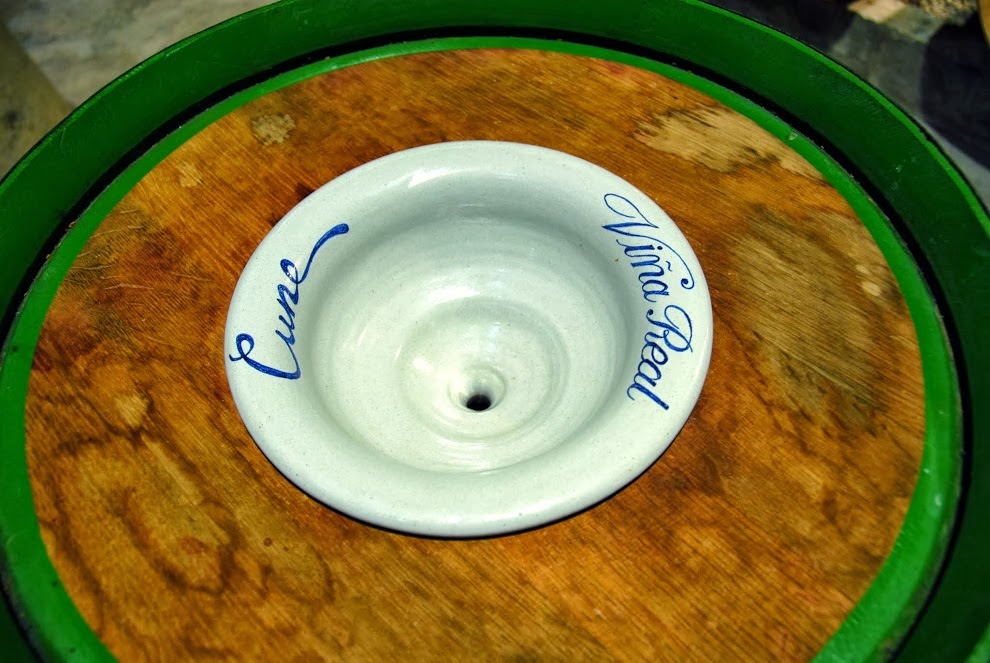
Viña Real (pronounced 'vinya ray-al') is a producer I've recently come to appreciate, with my first experience being the 1951 Rioja Gran Reserva that we drank to celebrate my mother-in-law's 60th birthday. On my recent trip to Spain, my husband and I visited a few wineries in Rioja, including this one. A modern structure built to resemble a huge wine vat (large tank) reminiscent of the old wooden vats from traditional winemaking, it's the recent home of a not-so-new label that was previously housed in the C.V.N.E. property in Haro, the winemaking city in the Rioja Alta sub-region. Compania Vinicola del Norte de España, also known as 'Cune,' is the winery where the company began in 1879. Viña Real's separate facility made of wood, concrete, and stainless steel opened in 2004 in the Rioja Alavesa sub-region and exclusively makes that label. In addition to the impressive structure and the feeling that we were inside a huge wine vat, the technology employed in this winery was like nothing I'd seen before. A huge crane works its way around the winery and transports what they call IFOs, identifiable flying objects, which are silver vessels that receive the grapes and then carry them over and into the stainless steel tanks for fermentation, enabling gravity-flow winemaking.


After alcoholic fermentation in the tanks the wine is transferred by gravity through hoses to the barrels on the lower level for aging. Once in barrel the Reserva wines will remain there for 18 months, being racked off the sediment every 6 months. A barrel washer speeds up the racking process, cleaning something like 200 barrels in a day. The most I could clean by hand was 17 in a day and after 2 days of that I was out of commission for a week! The winery has 2 long caves the size of 2 football field each built into the hill for barrel and bottle aging. Made of limestone, they remain cool and humid; they were built by the same outfit that constructed the subway tunnels in Bilbao, Spain. Penicillin mold grows all along the caves and barrels and bottles, and they believe this helps keep bacteria out of the winery and protect the wine from light and temperature variances.


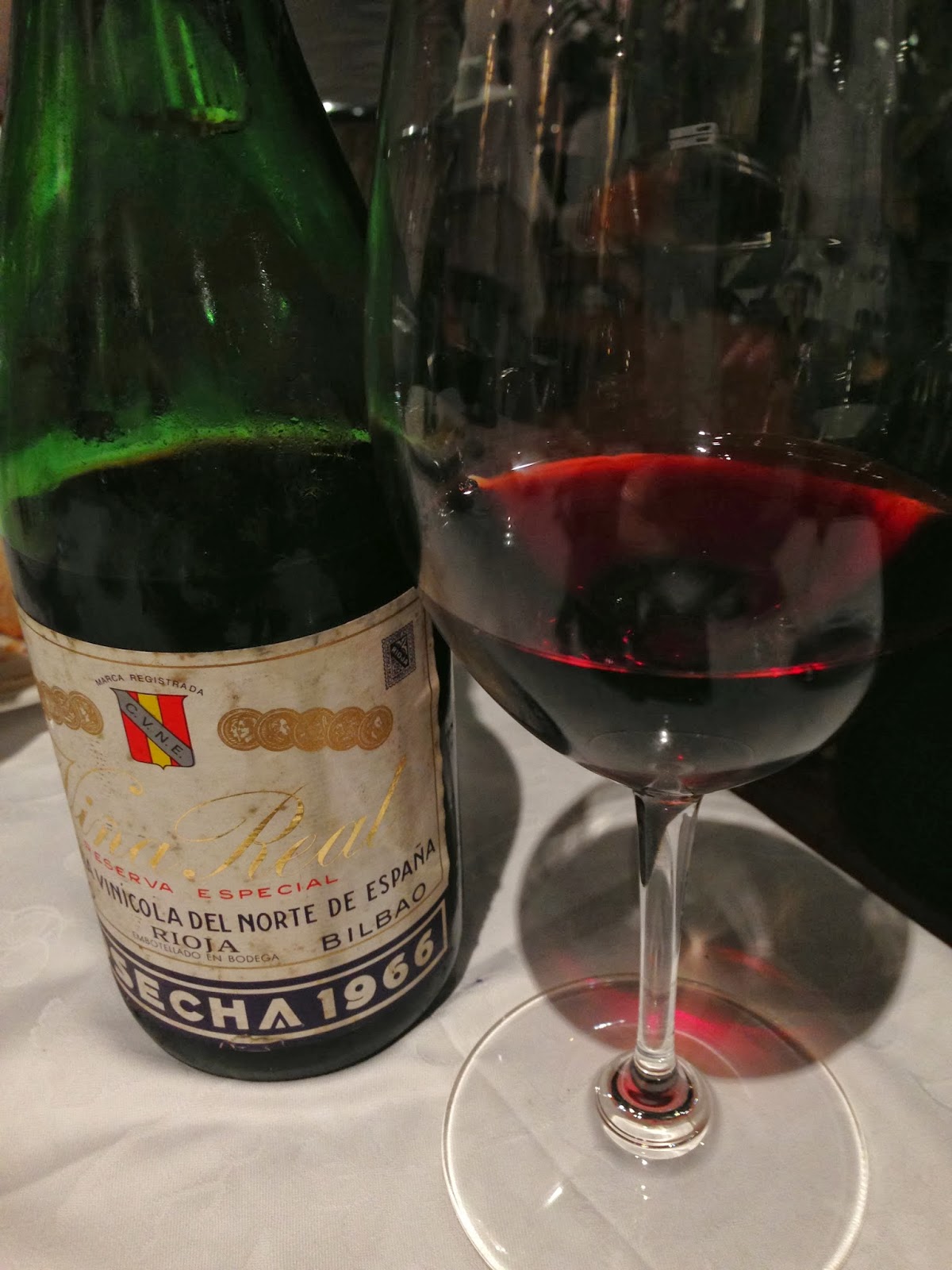
And now, the wine... at the winery we tasted their Crianza 2009, which was very pleasant with flavors of berries and balsamic. We bought a Magnum (double bottle) of the 2005 Gran Reserva (for 38 Euros! cheap!) to age it, since we know from experience that this wine ages tremendously. This may be our silver anniversary wine... but we could probably save it for the golden. Their Gran Reservas, not made every year, spend 7 years in the winery before release. At a restaurant in San Sebastian called Rekondo, known for its wine cellar, we ordered a bottle of Viña Real Rioja Gran Reserva 1966. The wine director uses heated metal to cut these older bottles off at the neck, just under the cork, rather than dealing with cork removal, which can be tricky in older wines. He also refuses to decant the wines, believing that drinking the wine from the bottle it aged in, with its sediment, is part of the experience. He brought us a small glass to try. Jeremy didn't even taste it; he gave it a brief swirl and sniff and then a knowing smile. The wine guy said, "that is all I need, that expression of pure joy on your face." We were so excited to try it.  At 47 years old, the wine was bright, fruity, leathery, spicy. Not at all stewed, oxidized, or tired. Perfect with the huge steak they put in front of us. Balanced, complex, smooth and alive, we couldn't believe how it shined.


After dinner we asked to see the wine cellar. The wine guy, from Argentina, explained that he is not a Sommelier or wine certified in any way. He just became interested in wine and learned everything he could about it, falling into this job by luck. The restaurant has an amazing wine collection, perhaps the best in Europe, and they source all their wines directly from the wineries so they know exactly where they came from and how they were stored. They have wines going back to the early 1920s. They have large format bottles - I don't even know if they have names for bottles so big - and I have no idea how you would pour from one. 

Truly an amazing experience, having seen the modernity of the new Viña Real space and experiencing the preserved age of the wines that preceded that space. I can't wait to see what our Magnum holds in store for us in the years to come.

Sunday, October 20, 2013

Rioja en Rioja

On a recent trip to Spain I spent 3 days in the famous wine region of Rioja, touring the vineyards and enjoying the wines. In the past I've described Rioja as my go-to wine. Drinkable, interesting, ageable, and versatile with a lot of foods, it is perhaps most importantly affordable.

In Rioja, wine laws dictate the aging and labeling of the wines, with the reds always being made from majority Tempranillo. Sometimes other grapes (Graciano, Mazuelo, Garnacha (Garnacha is the same grape as Grenache in France)) are included in small percentages (less than 15% of the wine). Minimum aging for a Rioja wine labeled Rioja Crianza is 2 years in the winery, of which 1 year must be in barrel. Rioja Reserva wines must be aged for at least 3 years in the winery, with 1 year being in barrel, and Rioja Gran Reserva must be aged for 5 years in the winery, with at least 2 of those years in barrel. This aging makes the wines both ready to drink and worthy of cellar time. The funny thing about these aging rules is that most wineries age their wines for longer, so either their Crianza ages for longer than required but still shorter than their Reserva, or they just don't make a Crianza.

White Rioja is generally made with a combination of Viura, Malvasia, and Garnacha Blanca, though Viura is by far the dominant grape. It is also known as Macabeo and stars prominently in Cava sparkling wine, Spain's version of Champagne, made in the Cava region. White Rioja is largely unknown in most of the world, but the Spaniards drink it up, and it's easy to see why. Some crisp and refreshing, others deep and complex, it was fun experiencing this wine as well.

When we planned to go to Rioja we had a vision in our heads that everything would be old, given the tradition of winemaking has been going on in Europe for way longer than the United States. But, the first winery we went to looked like this:


Very cool, but not old. Bodegas Ysios opened in 2001, setting a trend in avante-garde winery style. The name Ysios pays "homage to Isis and Osiris, two Egyptian gods closely related to the world of wine." Ysios produces only Rioja Reserva made only from Tempranillo, aged for 14 months in oak and a total of 3 years in the winery. 


Another super-modern winery that we visited, called Bodegas Baigorri, does a great tour and lunch tasting. The main tasting room is enclosed in a glass cube visible from the road, and the winery and restaurant reside in 7 floors below, built into the hill, with the winery operating by gravity-flow. Building underground provides for natural temperature and humidity control in the winery; concrete helps too. 


Lunch was delicious, and I particularly enjoyed the white and pink wines.


I like how they infused their wines in certain dishes... especially the dessert:


While modern in both their facilities and practices, these wineries uphold the traditions of the land. Not a bad way to start our visit in Rioja. 

More to come...  Salud!

Sunday, October 13, 2013

Txakoli - this is a wine


I discovered Txakoli on a recent trip to Spain's Basque country. Pronounced "cha-ko-lee," it's a refreshing, slightly sparkling wine made from native grapes in northern Spain. I visited the winery Txomin Etxaniz in the coastal Basque town of Getaria at the recommendation of a friend. Perched high in the hills, the views are amazing. We had a private tour and tasting with the young Aitor, son of the winemaker. Txomin is a family winery that has been traced all the way back to 1649. In 1989 they played a leading role in establishing the quality designation Denomination of Origin "Getariako Txakolina." In European countries wine is regulated by quality standards set by the government. Regulations may include the type of grapes allowed in specified regions made by certain winemaking techniques.  In order for Txakoli to carry the Denomination de Origin "Getariako Txakolina," it must be made from the native grapes Hondarrabi Zuri (white) and Hondarrabi Beltza (red) in Getaria. Each bottle carries a quality designation sticker like this:


The vineyards are trellised about 6 feet above the ground, forming a canopy that is really fun to walk under. It allows constant air flow beneath the vines, preventing mold and diseases from festering in the humid climate so close to the sea. Harvest usually occurs in October, and the grapes at Txomin are cooled before they are pressed. Fermentation is temperature controlled and the wine remains on its lees (dead yeast cells) for its entire life in the tank before bottling. Before fermentation is complete, the tank is closed off to allow some of the resultant carbon dioxide from the fermentation process to be trapped in the wine - this provides the light effervescence that Txakoli is known for. Cold stabilization precipitates out the tartrate crystals (from the high acidity) and then the wine is ready for bottling. Aitor described it as a "young wine," one that is meant for consumption within 1-2 years. Alcohol level is usually around 10-11%. 


Txakoli is a crisp wine that goes great with the local fish and seafood. At Txomin Etxaniz, Aitor served us a healthy sample of the wine alongside anchovies prepared in their kitchen. Then we went to the Getaria marina for lunch and had a bottle with Turbot, a delicious white fish.


To enjoy later on our trip, we got a bottle of their sparkling wine, which is made in the traditional Champagne method. Fittingly, we enjoyed that with some Basque cheese and baguette on the French side of Basque Country (in the beach town of Hendaye).


Continuing our trip around Basque country, I found that Txakoli went great with the pintxos (tapas) that we enjoyed in San Sebastian as we bar-hopped our way through dinner. And at 2 euros a glass, it was ok to try one at at each place.

Gracias, Aitor, for introducing us to this wine!

Sunday, September 8, 2013

The Year of the Shepherd

Last March at the Rhone Rangers Tasting in San Francisco, a meeting of California wine producers making Rhone varietals - syrah, mourvedre, grenache, cinsault, roussanne, marsanne, viognier - I tried the wines of producer Two Shepherds. Winemaker William Allen is a software developer by day and a wine producer by night, as of about 3 years ago. He is my hero because he started as a wine blogger (SimpleHedonisms.com) and made wine in his garage. When enough people told him he was onto something he decided to rent space in a winery collective in Santa Rosa and now makes about 500 cases per year, starting with the successful 2010 vintage.  William works every night and weekend on his wine, and he focuses on the varietals of the Rhone region of France because he loves those unique varietals. He focuses on "making wines that 'shepherd' grapes gently into non-manipulated and balanced old world style wines, while also guiding consumers back to wines of authenticity and to the wonderfully diverse realm of Rhone wines."

William has turned me on to Grenache Blanc, a rich and refreshing white that he makes. Those grapes come from the Santz Ynez Valley in Santa Barbara county while most of his other grapes come from the Russian River Valley of Sonoma county, but if William finds a vineyard he likes elsewhere he'll figure out how to get the grapes. William is all about low intervention and letting the winemaking process happen naturally. He allows the wines to ferment spontaneously from their native, naturally present yeasts. All of his wines go through natural malolactic fermentation, a process that softens their acidity, yet they are all still crisp, refreshing, and creamy, with a great texture that William is known for. He doesn't filter his wines nor cold stabilize, so if you put them in the fridge they will throw tartrates (no harm in that). The reds are aged in neutral oak which helps round them out without imparting oaky flavor.

Two Shepherds wines are a refreshing departure from typical big California wines - they are crisp, with bright acidity, depth of flavor, and balanced alcohol (around 13%). On a visit to his Santa Rosa facility in June (which he shares with Sheldon Micro-Winery and Krutz Family Cellars) we tasted more of the 2011 vintage and ended up joining our first wine club. A note on wine clubs - I don't really like them, mostly because they lock you into a certain amount of wine at regular intervals throughout the year. In the nearly 3 years that we've lived in San Francisco and after visiting countless wineries we have never had the desire to join a wine club and commit to certain wines for a year. Until now. William's club is flexible, with options for 4, 6 or 12 bottles per shipment, at 2 shipments per year. Since he makes many different bottlings in small quantities, some are only available to the wine club. So we are now "members of the flock" and privy to special wines and special events.


Some notes from our recent tastings (all 2011 vintage):

Grenache Blanc: yeasty nose, nice minerality, crisp yet creamy at the same time.

Centime: an "orange" wine made from co-fermenting Marsanne and Roussanne in stainless steel on their skins to impart some of the color, which develops into a pale orange wine. Coincidentally there is orange blossom scent on the nose combined with citrus on the palate. The wine is fresh, rich and smooth. A true geek wine, I was so excited to try this (and purchase my 1 bottle limit).

Pastoral Blanc: a blend of Roussanne, Marsanne, Viognier and Grenache Blanc. Perfumey, flowery nose, deep flavor and great acidity.

Syrah: exactly the type of Syrah I love - meaty and spicy with black pepper but rose-y and pretty at the same time. Aged 10 months in neutral oak.

Grenache: beautiful fresh berry nose, nice structure and acidity. Crushed/de-stemmed and fermented in small open-top fermenter, aged in neutral oak.

William has a great sense of humor and makes these fun t-shirts:


Separately, my sister gave birth to a beautiful baby boy this past April - his name is Shepherd. Here's my nephew at 4 months old:


Perhaps a future wine lover? 

To Shepherds!